
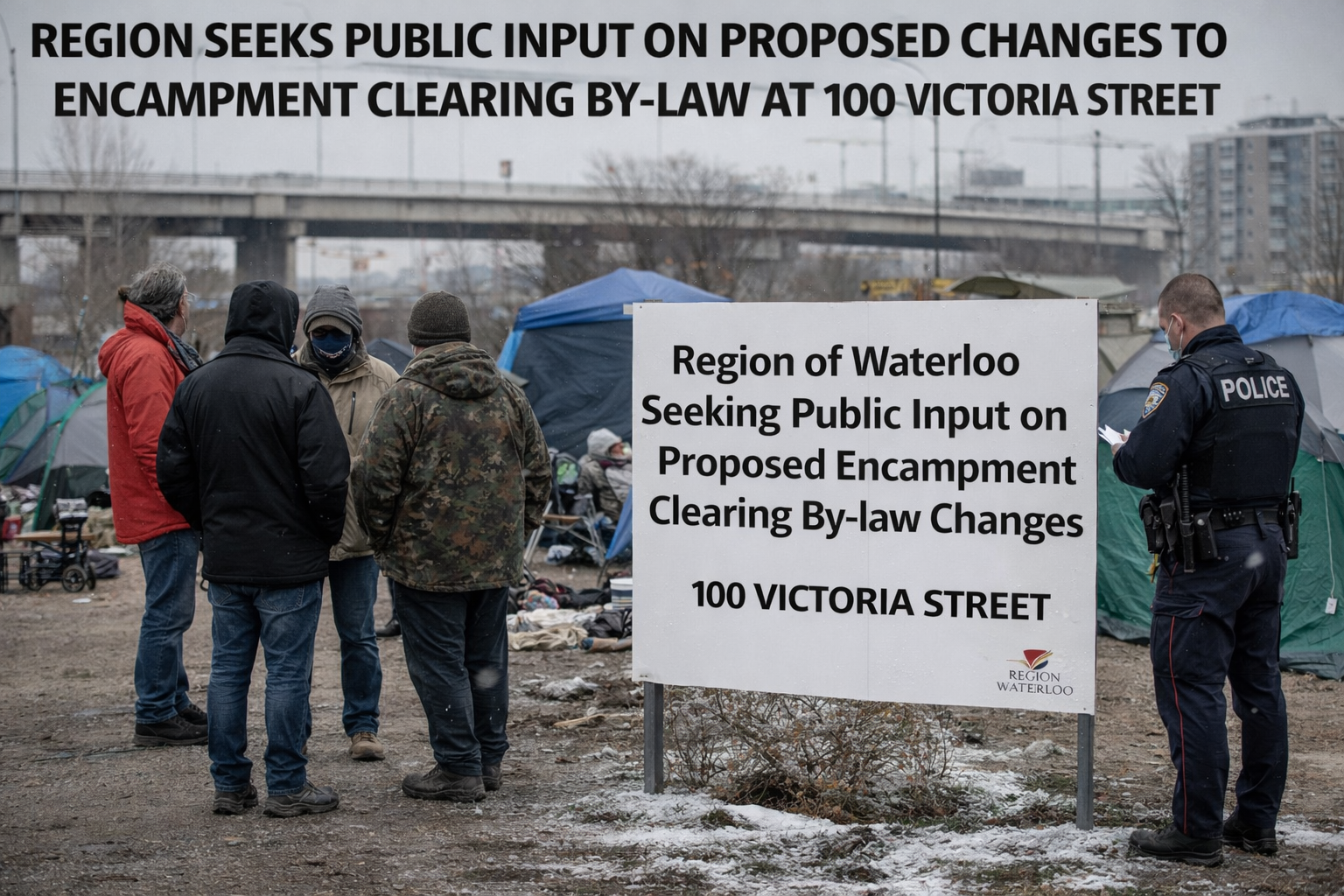
The Region of Waterloo is inviting public feedback as it considers proposed amendments to a controversial by-law aimed at clearing a homeless encampment at 100 Victoria Street North in Kitchener. Regional Council has scheduled a special public meeting in early January as part of its effort to gather community input ahead of an upcoming court hearing related to the by-law.
The site-specific by-law, originally passed in April 2025, was designed to facilitate the removal of the encampment to allow construction of the future Kitchener Central Transit Hub. Since its adoption, the by-law has faced legal challenges and mediation efforts, highlighting the complex intersection of housing insecurity, infrastructure development, and municipal authority.
Background: The 100 Victoria Street Encampment
One of the Largest Encampments in Waterloo Region
The encampment at 100 Victoria Street North is among the largest in the Waterloo Region and has been the focus of ongoing public debate for months. Located on land slated for a major regional transit project, the site has become symbolic of the broader housing and homelessness challenges facing the region.
As the number of people experiencing homelessness has increased, encampments like the one at Victoria Street have grown both in size and visibility. While the Region has emphasized safety, infrastructure needs, and long-term planning, advocates and residents have raised concerns about displacement, human rights, and the availability of suitable alternative housing.
Connection to the Kitchener Central Transit Hub
The land at 100 Victoria Street North has been identified as a key location for the planned Kitchener Central Transit Hub, a major infrastructure project intended to improve regional transit connectivity. The Region has said that clearing the site is necessary to allow construction to proceed on schedule.
Regional officials have maintained that delays to the project could have broader implications for transit users and long-term urban development. At the same time, the presence of the encampment has complicated timelines and sparked legal and ethical questions about how and when removal should occur.
The Site-Specific By-law Explained
Passed in April 2025
Waterloo Regional Council passed the 100 Victoria Street North Site Specific By-law on April 23, 2025. The by-law was designed to provide a legal mechanism for clearing the encampment and preparing the site for construction.
The decision was met with significant public interest and debate, with delegations both supporting and opposing the move. Supporters cited safety concerns and the importance of advancing transit infrastructure, while critics argued that clearing the encampment without adequate housing solutions would further marginalize vulnerable individuals.
Legal Challenges and Mediation Efforts
Following the by-law’s passage, mediation efforts began in November 2025 in an attempt to resolve disputes between the Region and individuals living at the site. Despite these efforts, no agreement was reached.
As a result, the matter is now headed to Superior Court, with a hearing scheduled for February 2026. The legal proceedings are expected to examine whether the by-law appropriately balances municipal authority with the rights of encampment residents.
Region Seeks Input Ahead of Court Proceedings
Special Public Meeting Scheduled
In advance of the court hearing, the Region has scheduled a special public meeting to gather community feedback on proposed amendments to the by-law. The meeting will take place on Wednesday, January 7, 2026, at Regional Council chambers located at 150 Frederick Street in Kitchener.
The meeting is set to begin at 6 p.m. and will provide an opportunity for residents, advocacy groups, and other stakeholders to share their perspectives directly with Regional Council.
According to the Region, the purpose of the meeting is to ensure that councillors have the benefit of public input before considering any changes to the by-law and before the matter proceeds further through the legal system.
Follow-Up Council Meeting on Amendments
Following the public meeting, Regional Council will review the proposed amendments during a special council meeting scheduled for Friday, January 9, 2026. That meeting will begin at 9 a.m.
At that time, councillors are expected to debate the amendments, consider feedback received from the public, and determine next steps. Any changes approved by council could influence the Region’s legal position as the February court date approaches.
Proposed Amendments: Details Still Emerging
Region Has Not Finalized Changes
While the Region has confirmed that amendments are being considered, specific details about the proposed changes have not yet been publicly released. Officials have indicated that the amendments are intended to address concerns raised during mediation and in public discourse.
By holding a public meeting before finalizing the amendments, the Region says it hopes to ensure transparency and demonstrate responsiveness to community concerns.
Balancing Infrastructure Needs and Human Impact
The challenge for Regional Council will be finding a balance between advancing a major infrastructure project and responding to the needs of individuals experiencing homelessness. The proposed amendments are expected to reflect that tension, as councillors weigh legal obligations, safety considerations, and social responsibility.
Ongoing Support for Encampment Residents
Housing Assistance Continues
In a press release, the Region emphasized that staff continue to provide support to individuals remaining at the 100 Victoria Street encampment. This includes working with residents on individual housing plans and connecting them with available services.
According to the Region, significant progress has already been made. Of the 26 individuals originally living at the site, 24 have secured alternative accommodations with the assistance of regional staff.
Focus on Individualized Solutions
Regional officials say their approach has focused on individualized support rather than one-size-fits-all solutions. Housing placements have included a range of options, depending on availability and individual needs.
The Region has framed this progress as evidence of its commitment to helping people transition out of encampments while acknowledging that challenges remain for those who have not yet been housed.
Broader Context: Homelessness and Policy Debate
A Region-Wide Issue
The situation at 100 Victoria Street North is part of a broader regional and provincial conversation about homelessness, housing affordability, and the role of municipalities in managing encampments.
Rising housing costs, limited shelter capacity, and gaps in supportive housing have contributed to an increase in visible encampments across Ontario. Municipal governments have increasingly found themselves navigating legal challenges as they attempt to balance enforcement with compassion.
Legal Landscape Continues to Evolve
Court decisions in recent years have shaped how municipalities can regulate encampments, particularly when adequate shelter alternatives are not available. These rulings have added complexity to local decision-making and have influenced how by-laws are written and enforced.
The upcoming Superior Court hearing in February 2026 is expected to be closely watched, as its outcome could have implications beyond Waterloo Region.
Community Engagement Seen as Key Step
Opportunity for Public Voices to Be Heard
The January 7 public meeting represents an opportunity for community members to weigh in on an issue that has generated strong opinions on all sides. Advocates for people experiencing homelessness are expected to call for protections and housing-first approaches, while others may emphasize public safety, land use, and infrastructure timelines.
Regional Council has indicated that hearing these perspectives is an important part of the decision-making process.
Transparency Ahead of Critical Decisions
By seeking public input before revisiting the by-law, the Region aims to demonstrate transparency at a time when trust and accountability are central concerns. The feedback received could influence not only the final wording of the amendments but also how the Region communicates its plans moving forward.
Next Steps and What to Expect
January Meetings Set the Stage
The early January meetings will mark a pivotal moment in the ongoing process. Public input on January 7 will inform council deliberations on January 9, potentially shaping the Region’s approach as it prepares for court in February.
Residents interested in participating are encouraged to attend the public meeting or follow council proceedings to stay informed.
Long-Term Implications Remain
While the immediate focus is on the by-law amendments and the court case, the broader issues of homelessness, housing supply, and infrastructure development will continue to challenge policymakers in Waterloo Region.
The outcome of this process may set precedents for how similar situations are handled in the future, both locally and beyond.
Conclusion: A Complex Issue at a Critical Juncture
As Waterloo Regional Council seeks public input on proposed changes to the 100 Victoria Street North Site Specific By-law, the Region finds itself at a critical juncture. With a major transit project planned, a court hearing looming, and the lives of vulnerable individuals at stake, the decisions made in the coming weeks will carry significant weight.
By opening the door to public feedback and emphasizing ongoing support for encampment residents, the Region is attempting to navigate a path forward that balances legal, social, and infrastructure considerations. How successfully it achieves that balance will become clearer as January’s meetings unfold and the February court date approaches.
Leave a Reply