
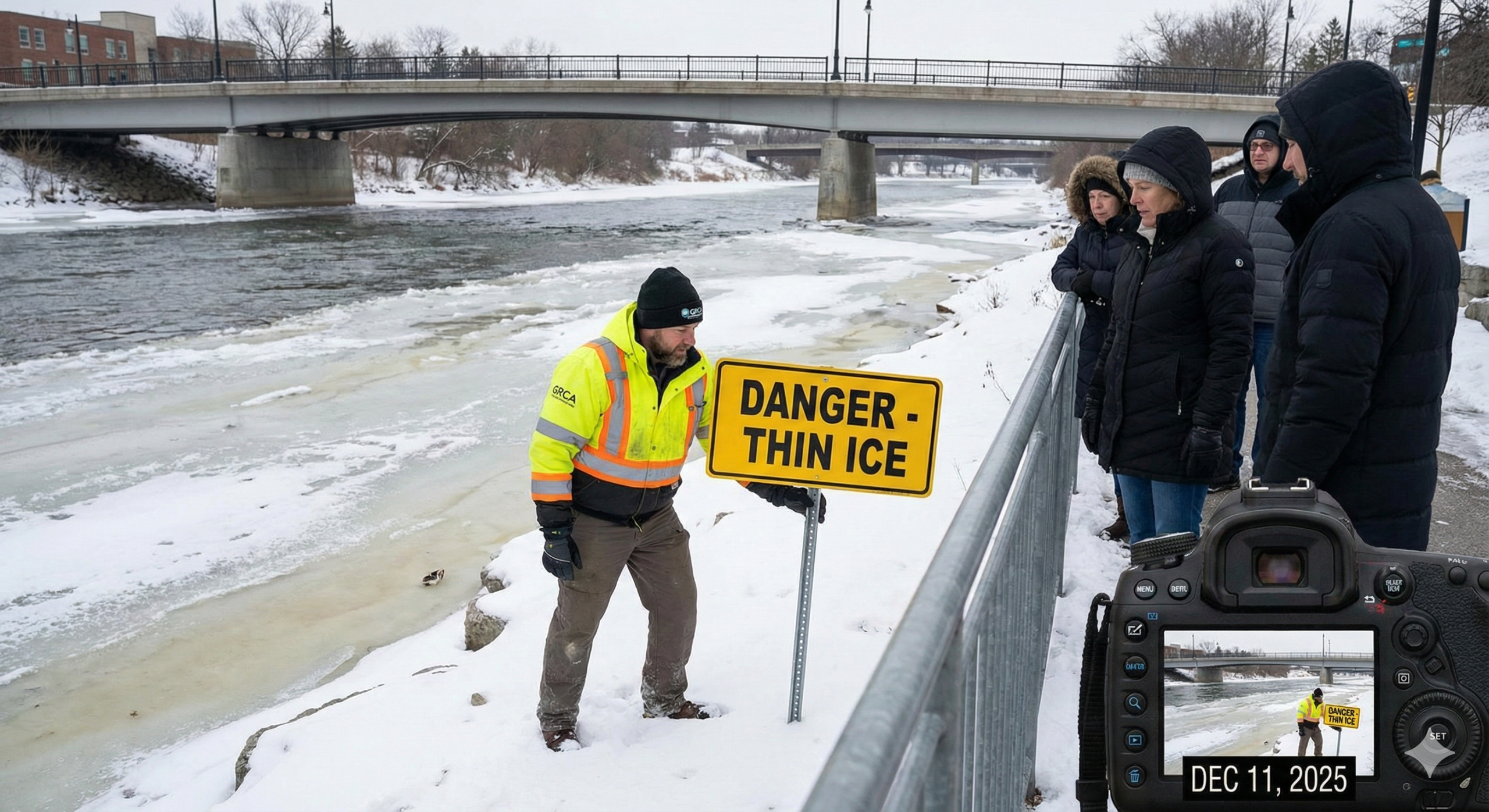
As early winter conditions settle into southern Ontario, the Grand River Conservation Authority (GRCA) is issuing a serious warning to residents across its watershed: stay off all frozen waterways. Despite the seemingly early formation of ice on rivers, reservoirs, ponds, and lakes, officials say the ice is dangerously thin, unstable, and unpredictable — posing significant risks to anyone attempting to venture onto it.
With fluctuating temperatures and rapidly shifting weather conditions, the GRCA is urging the public to exercise extreme caution near all waterways and to keep children and pets well away from banks and ice-covered surfaces.
Early Onset of Winter Creates Deceptively Thin Ice
Cold Weather Leading to Premature Ice Formation
The GRCA reports that colder-than-usual temperatures and early-season snowfall have contributed to the formation of thin ice on several bodies of water throughout the watershed. While the ice may give the appearance of an early freeze, officials stress that this ice is not yet strong enough to support any form of recreation — including walking, skating, or ice fishing.
“Recent cold temperatures and early-season snowfall have resulted in the formation of thin ice on local rivers, reservoirs, ponds, and lakes across the watershed,” the GRCA said in its advisory. “While ice may appear to be forming earlier than in previous years, ice conditions remain highly unstable, unpredictable, and unsafe for any type of recreation.”
Thin Ice Often Misleading
Visual cues alone are not enough to determine whether ice is safe. The GRCA warns that thin ice can often look deceptively solid from a distance. Its colour, texture, or surface appearance does not reliably indicate its thickness.
This lack of clarity frequently leads individuals — particularly children — to venture onto unsafe ice, believing it to be secure. Such situations can quickly turn dangerous, especially when ice suddenly gives way or when individuals find themselves unable to climb out of frigid, fast-moving water.
Danger Near Shorelines and Fast-Moving Currents
Walking Near Banks Comes with Hidden Hazards
Beyond the threat of falling through thin ice, simply walking along the edges of rivers and creeks can be hazardous this time of year. The GRCA cautions that banks are often slippery due to frost, snow, and early freeze-thaw cycles. When combined with high flows and cold currents, even a slip from the shoreline can become life-threatening.
“The public is encouraged to exercise extreme caution around all local waterways and is strongly advised to stay off all ice at this time,” the GRCA advised. “Parents and caregivers are urged to keep children and pets away from shorelines and off frozen surfaces, as conditions can change quickly.”
Fast-Moving Water Prevents Stable Ice Formation
Rivers, reservoirs, and waterways within the GRCA’s system experience frequent and sometimes dramatic fluctuations in water levels. These changes — influenced by precipitation, upstream flows, water control structures, and seasonal patterns — prevent stable ice formation.
The GRCA warns that even during cold snaps, ice thickness can vary significantly from one area to the next. Underwater currents can erode ice from below, creating weak layers that collapse without warning.
“It is important to note that river systems, reservoirs, and water control structures experience fluctuating water levels and variable flows that prevent stable ice formation,” the GRCA said. “While colder temperatures allow for some ice formation, daily changes in temperature, wind, precipitation, and underwater currents greatly affect ice conditions.”
Local Incidents Highlight the Risks
A Seasonal Pattern of Emergencies
While this advisory aims to prevent incidents, officials note that early winter often leads to an uptick in calls involving people, pets, or wildlife venturing onto unstable ice. Each year, fire departments and rescue teams respond to emergency situations caused by misjudging ice conditions.
Local safety advocates stress that no ice is safe ice at this point in the season — especially near dams, inlets, outlets, or anywhere water is flowing beneath the surface.
Recreation Options Available — But Not on These Waterways
Designated Conservation Areas Monitor Ice Conditions
Although the GRCA is strongly advising residents to avoid natural bodies of frozen water for now, the agency acknowledges that winter recreation remains an important part of the season for many families. To that end, several Grand River Conservation Areas monitor ice conditions closely and may offer safe winter activities once conditions are suitable.
“Select Grand River Conservation Areas, including Belwood Lake, Guelph Lake, Pinehurst Lake, and Shade’s Mills, are monitoring ice conditions and will offer ice fishing if conditions permit,” the GRCA noted.
These locations follow strict safety protocols, measuring ice thickness and stability before allowing visitors to participate in activities such as ice fishing.
Safe Skating Options in Local Municipalities
In addition to conservation areas, many municipalities within the watershed offer safer alternatives for winter recreation, including outdoor skating rinks, maintained trails, and supervised winter parks.
Unlike natural water bodies, municipal rinks are maintained, measured, and assessed regularly to ensure the skating surface is safe and properly supported.
Public Encouraged to Stay Informed and Stay Safe
Ice Safety Tips from Authorities
To help residents avoid dangerous situations, the GRCA and local emergency services provide several key reminders:
-
Do not walk on rivers, ponds, reservoirs, or lakes at this time.
-
Keep children and pets well away from shorelines and frozen surfaces.
-
Use designated skating areas maintained by municipalities.
-
Avoid walking along slippery banks near fast-moving water.
-
Remain aware that ice conditions can change hour by hour.
Officials emphasize that even on extremely cold days, natural ice cannot be assumed to be safe — especially on rivers and reservoirs affected by fluctuating flows.
Why Early-Winter Ice Is Especially Dangerous
Early-season ice is almost always unpredictable because:
-
Water temperatures vary more widely.
-
Daytime sunshine weakens thin ice.
-
Snowfall insulates the ice, slowing the freezing process.
-
Underwater currents erode ice from below.
-
Temperature swings cause rapid expansion and contraction, creating cracks and air pockets.
These factors combine to create an unstable foundation that may look solid but can break instantly under minimal weight.
Conclusion: Safety First as Winter Begins
As winter settles in and colder temperatures become more consistent, the GRCA’s message remains clear: do not trust early ice. Despite the temptation to venture out for seasonal activities, the risks far outweigh the rewards during this volatile early freeze.
The conservation authority’s warning serves as a crucial reminder for residents across the watershed to keep safety top of mind, avoid frozen water bodies, and rely on official recreational sites until conditions improve. With more winter weather expected in the coming weeks, staying informed, making cautious decisions, and prioritizing public safety will be essential for preventing accidents and protecting lives.
Leave a Reply